# Nepenthes
# * List of all Nepenthes species
**Number of Nepenthes species listed here: 192**
## **A**
- [Nepenthes abalata](https://carnipedia.org/books/nepenthes/page/nepenthes-abalata)
- [Nepenthes abgracilis](https://carnipedia.org/books/nepenthes/page/nepenthes-abgracilis)
- [Nepenthes adnata](https://carnipedia.org/books/nepenthes/page/nepenthes-adnata)
- [Nepenthes adrianii](https://carnipedia.org/books/nepenthes/page/nepenthes-adrianii)
- [Nepenthes aenigma](https://carnipedia.org/books/nepenthes/page/nepenthes-aenigma)
- [Nepenthes alata](https://carnipedia.org/books/nepenthes/page/nepenthes-alata)
- [Nepenthes alba](https://carnipedia.org/books/nepenthes/page/nepenthes-alba)
- [Nepenthes albomarginata](https://carnipedia.org/books/nepenthes/page/nepenthes-albomarginata)
- [Nepenthes alfedoi](https://carnipedia.org/books/nepenthes/page/nepenthes-alfedoi)
- [Nepenthes alzapan](https://carnipedia.org/books/nepenthes/page/nepenthes-alzapan)
- [Nepenthes ampullaria](https://carnipedia.org/books/nepenthes/page/nepenthes-ampullaria)
- [Nepenthes andamana](https://carnipedia.org/books/nepenthes/page/nepenthes-andamana)
- [Nepenthes angasanensis](https://carnipedia.org/books/nepenthes/page/nepenthes-angasanensis)
- [Nepenthes appendiculata](https://carnipedia.org/books/nepenthes/page/nepenthes-appendiculata)
- [Nepenthes argentii](https://carnipedia.org/books/nepenthes/page/nepenthes-argentii)
- [Nepenthes aristolochioides](https://carnipedia.org/books/nepenthes/page/nepenthes-aristolochioides)
- [Nepenthes armin](https://carnipedia.org/books/nepenthes/page/nepenthes-armin)
- [Nepenthes attenboroughii](https://carnipedia.org/books/nepenthes/page/nepenthes-attenboroughii)
## **B**
- [Nepenthes barcelonae](https://carnipedia.org/books/nepenthes/page/nepenthes-barcelonae)
- [Nepenthes batik](https://carnipedia.org/books/nepenthes/page/nepenthes-batik)
- [Nepenthes beccariana](https://carnipedia.org/books/nepenthes/page/nepenthes-beccariana)
- [Nepenthes bellii](https://carnipedia.org/books/nepenthes/page/nepenthes-bellii)
- [Nepenthes benstonei](https://carnipedia.org/books/nepenthes/page/nepenthes-benstonei)
- [Nepenthes berbulu](https://carnipedia.org/books/nepenthes/page/nepenthes-berbulu)
- [Nepenthes biak](https://carnipedia.org/books/nepenthes/page/nepenthes-biak)
- [Nepenthes bicalcarata](https://carnipedia.org/books/nepenthes/page/nepenthes-bicalcarata)
- [Nepenthes bokorensis](https://carnipedia.org/books/nepenthes/page/nepenthes-bokorensis)
- [Nepenthes bongso](https://carnipedia.org/books/nepenthes/page/nepenthes-bongso)
- [Nepenthes boschiana](https://carnipedia.org/books/nepenthes/page/nepenthes-boschiana)
- [Nepenthes bracteosa](https://carnipedia.org/books/nepenthes/page/nepenthes-bracteosa)
- [Nepenthes burbidgeae](https://carnipedia.org/books/nepenthes/page/nepenthes-burbidgeae)
- [Nepenthes burkei](https://carnipedia.org/books/nepenthes/page/nepenthes-burkei)
## **C**
- [Nepenthes cabanae](https://carnipedia.org/books/nepenthes/page/nepenthes-cabanae)
- [Nepenthes campanulata](https://carnipedia.org/books/nepenthes/page/nepenthes-campanulata)
- [Nepenthes ceciliae](https://carnipedia.org/books/nepenthes/page/nepenthes-ceciliae)
- [Nepenthes chang](https://carnipedia.org/books/nepenthes/page/nepenthes-chang)
- [Nepenthes chaniana](https://carnipedia.org/books/nepenthes/page/nepenthes-chaniana)
- [Nepenthes cid](https://carnipedia.org/books/nepenthes/page/nepenthes-cid)
- [Nepenthes clipeata](https://carnipedia.org/books/nepenthes/page/nepenthes-clipeata)
- [Nepenthes copelandii](https://carnipedia.org/books/nepenthes/page/nepenthes-copelandii)
- [Nepenthes cornuta](https://carnipedia.org/books/nepenthes/page/nepenthes-cornuta)
## **D**
- [Nepenthes dactylifera](https://carnipedia.org/books/nepenthes/page/nepenthes-dactylifera)
- [Nepenthes danseri](https://carnipedia.org/books/nepenthes/page/nepenthes-danseri)
- [Nepenthes deaniana](https://carnipedia.org/books/nepenthes/page/nepenthes-deaniana)
- [Nepenthes densiflora](https://carnipedia.org/books/nepenthes/page/nepenthes-densiflora)
- [Nepenthes diabolica](https://carnipedia.org/books/nepenthes/page/nepenthes-diabolica)
- [Nepenthes diatas](https://carnipedia.org/books/nepenthes/page/nepenthes-diatas)
- [Nepenthes distillatoria](https://carnipedia.org/books/nepenthes/page/nepenthes-distillatoria)
- [Nepenthes domei](https://carnipedia.org/books/nepenthes/page/nepenthes-domei)
- [Nepenthes dubia](https://carnipedia.org/books/nepenthes/page/nepenthes-dubia)
## **E**
- [Nepenthes edwardsiana](https://carnipedia.org/books/nepenthes/page/nepenthes-edwardsiana)
- [Nepenthes ephippiata](https://carnipedia.org/books/nepenthes/page/nepenthes-ephippiata)
- [Nepenthes epiphytica](https://carnipedia.org/books/nepenthes/page/nepenthes-epiphytica)
- [Nepenthes erucoides](https://carnipedia.org/books/nepenthes/page/nepenthes-erucoides)
- [Nepenthes eustachya](https://carnipedia.org/books/nepenthes/page/nepenthes-eustachya)
- [Nepenthes extincta](https://carnipedia.org/books/nepenthes/page/nepenthes-extincta)
- [Nepenthes eymae](https://carnipedia.org/books/nepenthes/page/nepenthes-eymae)
## **F**
- [Nepenthes faizaliana](https://carnipedia.org/books/nepenthes/page/nepenthes-faizaliana)
- [Nepenthes flava](https://carnipedia.org/books/nepenthes/page/nepenthes-flava)
- [Nepenthes fractiflexa](https://carnipedia.org/books/nepenthes/page/nepenthes-fractiflexa)
- [Nepenthes fusca](https://carnipedia.org/books/nepenthes/page/nepenthes-fusca)
## **G**
- [Nepenthes gantungensis](https://carnipedia.org/books/nepenthes/page/nepenthes-gantungensis)
- [Nepenthes glabrata](https://carnipedia.org/books/nepenthes/page/nepenthes-glabrata)
- [Nepenthes glandulifera](https://carnipedia.org/books/nepenthes/page/nepenthes-glandulifera)
- [Nepenthes graciliflora](https://carnipedia.org/books/nepenthes/page/nepenthes-graciliflora)
- [Nepenthes gracilis](https://carnipedia.org/books/nepenthes/page/nepenthes-gracilis)
- [Nepenthes gracillima](https://carnipedia.org/books/nepenthes/page/nepenthes-gracillima)
- [Nepenthes gymnamphora](https://carnipedia.org/books/nepenthes/page/nepenthes-gymnamphora)
## **H**
- [Nepenthes halmahera](https://carnipedia.org/books/nepenthes/page/nepenthes-halmahera)
- [Nepenthes hamata](https://carnipedia.org/books/nepenthes/page/nepenthes-hamata)
- [Nepenthes hamiguitanensis](https://carnipedia.org/books/nepenthes/page/nepenthes-hamiguitanensis)
- [Nepenthes harauensis](https://carnipedia.org/books/nepenthes/page/nepenthes-harauensis)
- [Nepenthes hemsleyana](https://carnipedia.org/books/nepenthes/page/nepenthes-hemsleyana)
- [Nepenthes higaonon](https://carnipedia.org/books/nepenthes/page/nepenthes-higaonon)
- [Nepenthes hirsuta](https://carnipedia.org/books/nepenthes/page/nepenthes-hirsuta)
- [Nepenthes hirtella](https://carnipedia.org/books/nepenthes/page/nepenthes-hirtella)
- [Nepenthes hispida](https://carnipedia.org/books/nepenthes/page/nepenthes-hispida)
- [Nepenthes holdenii](https://carnipedia.org/books/nepenthes/page/nepenthes-holdenii)
## **I**
- [Nepenthes inermis](https://carnipedia.org/books/nepenthes/page/nepenthes-inermis)
- [Nepenthes insignis](https://carnipedia.org/books/nepenthes/page/nepenthes-insignis)
- [Nepenthes izumiae](https://carnipedia.org/books/nepenthes/page/nepenthes-izumiae)
## **J**
- [Nepenthes jacquelineae](https://carnipedia.org/books/nepenthes/page/nepenthes-jacquelineae)
- [Nepenthes jamban](https://carnipedia.org/books/nepenthes/page/nepenthes-jamban)
- [Nepenthes junghuhnii](https://carnipedia.org/books/nepenthes/page/nepenthes-junghuhnii)
- [Nepenthes justinae](https://carnipedia.org/books/nepenthes/page/nepenthes-justinae)
## **K**
- [Nepenthes kampalili](https://carnipedia.org/books/nepenthes/page/nepenthes-kampalili)
- [Nepenthes kampotiana](https://carnipedia.org/books/nepenthes/page/nepenthes-kampotiana)
- [Nepenthes kerrii](https://carnipedia.org/books/nepenthes/page/nepenthes-kerrii)
- [Nepenthes khasiana](https://carnipedia.org/books/nepenthes/page/nepenthes-khasiana)
- [Nepenthes kitanglad](https://carnipedia.org/books/nepenthes/page/nepenthes-kitanglad)
- [Nepenthes klossii](https://carnipedia.org/books/nepenthes/page/nepenthes-klossii)
- [Nepenthes kongkandana](https://carnipedia.org/books/nepenthes/page/nepenthes-kongkandana)
- [Nepenthes krabiensis](https://carnipedia.org/books/nepenthes/page/nepenthes-krabiensis)
## **L**
- [Nepenthes lamii](https://carnipedia.org/books/nepenthes/page/nepenthes-lamii)
- [Nepenthes latiffiana](https://carnipedia.org/books/nepenthes/page/nepenthes-latiffiana)
- [Nepenthes lavicola](https://carnipedia.org/books/nepenthes/page/nepenthes-lavicola)
- [Nepenthes leonardoi](https://carnipedia.org/books/nepenthes/page/nepenthes-leonardoi)
- [Nepenthes leyte](https://carnipedia.org/books/nepenthes/page/nepenthes-leyte)
- [Nepenthes lingulata](https://carnipedia.org/books/nepenthes/page/nepenthes-lingulata)
- [Nepenthes longifolia](https://carnipedia.org/books/nepenthes/page/nepenthes-longifolia)
- [Nepenthes longiptera](https://carnipedia.org/books/nepenthes/page/nepenthes-longiptera)
- [Nepenthes lowii](https://carnipedia.org/books/nepenthes/page/nepenthes-lowii)
## **M**
- [Nepenthes maagnawensis](https://carnipedia.org/books/nepenthes/page/nepenthes-maagnawensis)
- [Nepenthes macfarlanei](https://carnipedia.org/books/nepenthes/page/nepenthes-macfarlanei)
- [Nepenthes macrophylla](https://carnipedia.org/books/nepenthes/page/nepenthes-macrophylla)
- [Nepenthes macrovulgaris](https://carnipedia.org/books/nepenthes/page/nepenthes-macrovulgaris)
- [Nepenthes madagascariensis](https://carnipedia.org/books/nepenthes/page/nepenthes-madagascariensis)
- [Nepenthes malayensis](https://carnipedia.org/books/nepenthes/page/nepenthes-malayensis)
- [Nepenthes malimumuensis](https://carnipedia.org/books/nepenthes/page/nepenthes-malimumuensis)
- [Nepenthes manobo](https://carnipedia.org/books/nepenthes/page/nepenthes-manobo)
- [Nepenthes mantalingajanensis](https://carnipedia.org/books/nepenthes/page/nepenthes-mantalingajanensis)
- [Nepenthes mapuluensis](https://carnipedia.org/books/nepenthes/page/nepenthes-mapuluensis)
- [Nepenthes maryae](https://carnipedia.org/books/nepenthes/page/nepenthes-maryae)
- [Nepenthes masoalensis](https://carnipedia.org/books/nepenthes/page/nepenthes-masoalensis)
- [Nepenthes maxima](https://carnipedia.org/books/nepenthes/page/nepenthes-maxima)
- [Nepenthes megastoma](https://carnipedia.org/books/nepenthes/page/nepenthes-megastoma)
- [Nepenthes merrilliana](https://carnipedia.org/books/nepenthes/page/nepenthes-merrilliana)
- [Nepenthes micramphora](https://carnipedia.org/books/nepenthes/page/nepenthes-micramphora)
- [Nepenthes mikei](https://carnipedia.org/books/nepenthes/page/nepenthes-mikei)
- [Nepenthes mindanacensis](https://carnipedia.org/books/nepenthes/page/nepenthes-mindanacensis)
- [Nepenthes minima](https://carnipedia.org/books/nepenthes/page/nepenthes-minima)
- [Nepenthes mira](https://carnipedia.org/books/nepenthes/page/nepenthes-mira)
- [Nepenthes mirabilis](https://carnipedia.org/books/nepenthes/page/nepenthes-mirabilis)
- [Nepenthes misoolensis](https://carnipedia.org/books/nepenthes/page/nepenthes-misoolensis)
- [Nepenthes mollis](https://carnipedia.org/books/nepenthes/page/nepenthes-mollis)
- [Nepenthes monticola](https://carnipedia.org/books/nepenthes/page/nepenthes-monticola)
- [Nepenthes muluensis](https://carnipedia.org/books/nepenthes/page/nepenthes-muluensis)
- [Nepenthes murudensis](https://carnipedia.org/books/nepenthes/page/nepenthes-murudensis)
## **N**
- [Nepenthes naga](https://carnipedia.org/books/nepenthes/page/nepenthes-naga)
- [Nepenthes nebularum](https://carnipedia.org/books/nepenthes/page/nepenthes-nebularum)
- [Nepenthes negros](https://carnipedia.org/books/nepenthes/page/nepenthes-negros)
- [Nepenthes neoguineensis](https://carnipedia.org/books/nepenthes/page/nepenthes-neoguineensis)
- [Nepenthes nigra](https://carnipedia.org/books/nepenthes/page/nepenthes-nigra)
- [Nepenthes northiana](https://carnipedia.org/books/nepenthes/page/nepenthes-northiana)
## **O**
- [Nepenthes orbiculata](https://carnipedia.org/books/nepenthes/page/nepenthes-orbiculata)
- [Nepenthes ovata](https://carnipedia.org/books/nepenthes/page/nepenthes-ovata)
## **P**
- [Nepenthes palawanensis](https://carnipedia.org/books/nepenthes/page/nepenthes-palawanensis)
- [Nepenthes paniculata](https://carnipedia.org/books/nepenthes/page/nepenthes-paniculata)
- [Nepenthes pantaronensis](https://carnipedia.org/books/nepenthes/page/nepenthes-pantaronensis)
- [Nepenthes papuana](https://carnipedia.org/books/nepenthes/page/nepenthes-papuana)
- [Nepenthes parvula](https://carnipedia.org/books/nepenthes/page/nepenthes-parvula)
- [Nepenthes pectinata](https://carnipedia.org/books/nepenthes/page/nepenthes-pectinata)
- [Nepenthes peltata](https://carnipedia.org/books/nepenthes/page/nepenthes-peltata)
- [Nepenthes pervillei](https://carnipedia.org/books/nepenthes/page/nepenthes-pervillei)
- [Nepenthes petiolata](https://carnipedia.org/books/nepenthes/page/nepenthes-petiolata)
- [Nepenthes philippinensis](https://carnipedia.org/books/nepenthes/page/nepenthes-philippinensis)
- [Nepenthes pilosa](https://carnipedia.org/books/nepenthes/page/nepenthes-pilosa)
- [Nepenthes pitopangii](https://carnipedia.org/books/nepenthes/page/nepenthes-pitopangii)
- [Nepenthes platychila](https://carnipedia.org/books/nepenthes/page/nepenthes-platychila)
- [Nepenthes pongoides](https://carnipedia.org/books/nepenthes/page/nepenthes-pongoides)
- [Nepenthes pudica](https://carnipedia.org/books/nepenthes/page/nepenthes-pudica)
- [Nepenthes pulchra](https://carnipedia.org/books/nepenthes/page/nepenthes-pulchra)
- [Nepenthes putaiguneung](https://carnipedia.org/books/nepenthes/page/nepenthes-putaiguneung)
## **R**
- [Nepenthes rafflesiana](https://carnipedia.org/books/nepenthes/page/nepenthes-rafflesiana)
- [Nepenthes rajah](https://carnipedia.org/books/nepenthes/page/nepenthes-rajah)
- [Nepenthes ramispina](https://carnipedia.org/books/nepenthes/page/nepenthes-ramispina)
- [Nepenthes ramos](https://carnipedia.org/books/nepenthes/page/nepenthes-ramos)
- [Nepenthes reinwardtiana](https://carnipedia.org/books/nepenthes/page/nepenthes-reinwardtiana)
- [Nepenthes rhombicaulis](https://carnipedia.org/books/nepenthes/page/nepenthes-rhombicaulis)
- [Nepenthes rigidifolia](https://carnipedia.org/books/nepenthes/page/nepenthes-rigidifolia)
- [Nepenthes robcantleyi](https://carnipedia.org/books/nepenthes/page/nepenthes-robcantleyi)
- [Nepenthes rosea](https://carnipedia.org/books/nepenthes/page/nepenthes-rosea)
- [Nepenthes rowaniae](https://carnipedia.org/books/nepenthes/page/nepenthes-rowaniae)
## **S**
- [Nepenthes samar](https://carnipedia.org/books/nepenthes/page/nepenthes-samar)
- [Nepenthes sanguinea](https://carnipedia.org/books/nepenthes/page/nepenthes-sanguinea)
- [Nepenthes saranganiensis](https://carnipedia.org/books/nepenthes/page/nepenthes-saranganiensis)
- [Nepenthes sericea](https://carnipedia.org/books/nepenthes/page/nepenthes-sericea)
- [Nepenthes sibuyanensis](https://carnipedia.org/books/nepenthes/page/nepenthes-sibuyanensis)
- [Nepenthes singalana](https://carnipedia.org/books/nepenthes/page/nepenthes-singalana)
- [Nepenthes smilesii](https://carnipedia.org/books/nepenthes/page/nepenthes-smilesii)
- [Nepenthes spathulata](https://carnipedia.org/books/nepenthes/page/nepenthes-spathulata)
- [Nepenthes spectabilis](https://carnipedia.org/books/nepenthes/page/nepenthes-spectabilis)
- [Nepenthes stenophylla](https://carnipedia.org/books/nepenthes/page/nepenthes-stenophylla)
- [Nepenthes sumagaya](https://carnipedia.org/books/nepenthes/page/nepenthes-sumagaya)
- [Nepenthes sumatrana](https://carnipedia.org/books/nepenthes/page/nepenthes-sumatrana)
- [Nepenthes suratensis](https://carnipedia.org/books/nepenthes/page/nepenthes-suratensis)
- [Nepenthes surigacensis](https://carnipedia.org/books/nepenthes/page/nepenthes-surigacensis)
## **T**
- [Nepenthes talaandig](https://carnipedia.org/books/nepenthes/page/nepenthes-talaandig)
- [Nepenthes talangensis](https://carnipedia.org/books/nepenthes/page/nepenthes-talangensis)
- [Nepenthes taminii](https://carnipedia.org/books/nepenthes/page/nepenthes-taminii)
- [Nepenthes tayninhensis](https://carnipedia.org/books/nepenthes/page/nepenthes-tayninhensis)
- [Nepenthes tboli](https://carnipedia.org/books/nepenthes/page/nepenthes-tboli)
- [Nepenthes tenax](https://carnipedia.org/books/nepenthes/page/nepenthes-tenax)
- [Nepenthes tentaculata](https://carnipedia.org/books/nepenthes/page/nepenthes-tentaculata)
- [Nepenthes tenuis](https://carnipedia.org/books/nepenthes/page/nepenthes-tenuis)
- [Nepenthes thai](https://carnipedia.org/books/nepenthes/page/nepenthes-thai)
- [Nepenthes thorelii](https://carnipedia.org/books/nepenthes/page/nepenthes-thorelii)
- [Nepenthes tobaica](https://carnipedia.org/books/nepenthes/page/nepenthes-tobaica)
- [Nepenthes tomoriana](https://carnipedia.org/books/nepenthes/page/nepenthes-tomoriana)
- [Nepenthes treubiana](https://carnipedia.org/books/nepenthes/page/nepenthes-treubiana)
- [Nepenthes truncata](https://carnipedia.org/books/nepenthes/page/nepenthes-truncata)
## **U**
- [Nepenthes ultra](https://carnipedia.org/books/nepenthes/page/nepenthes-ultra)
- [Nepenthes ulukaliana](https://carnipedia.org/books/nepenthes/page/nepenthes-ulukaliana)
- [Nepenthes undulatifolia](https://carnipedia.org/books/nepenthes/page/nepenthes-undulatifolia)
## **V**
- [Nepenthes veitchii](https://carnipedia.org/books/nepenthes/page/nepenthes-veitchii)
- [Nepenthes ventricosa](https://carnipedia.org/books/nepenthes/page/nepenthes-ventricosa)
- [Nepenthes vieillardii](https://carnipedia.org/books/nepenthes/page/nepenthes-vieillardii)
- [Nepenthes villosa](https://carnipedia.org/books/nepenthes/page/nepenthes-villosa)
- [Nepenthes viridis](https://carnipedia.org/books/nepenthes/page/nepenthes-viridis)
- [Nepenthes vogelii](https://carnipedia.org/books/nepenthes/page/nepenthes-vogelii)
## **W**
- [Nepenthes weda](https://carnipedia.org/books/nepenthes/page/nepenthes-weda)
## **X**
- [Nepenthes xiphioides](https://carnipedia.org/books/nepenthes/page/nepenthes-xiphioides)
## **Z**
- [Nepenthes zakriana](https://carnipedia.org/books/nepenthes/page/nepenthes-zakriana)
- [Nepenthes zygon](https://carnipedia.org/books/nepenthes/page/nepenthes-zygon)
# * Nepenthes Distribution Map
- [Worldwide](https://www.inaturalist.org/observations?taxon_id=52646)
- [India](https://www.inaturalist.org/observations?place_id=6681&subview=map&taxon_id=52646)
- [Sri Lanka](https://www.inaturalist.org/observations?place_id=7077&subview=map&taxon_id=52646)
- [Thailand](https://www.inaturalist.org/observations?place_id=6967&subview=map&taxon_id=52646)
- [Malaysia](https://www.inaturalist.org/observations?place_id=7155&subview=map&taxon_id=52646)
- [Peninsular Malaysia](https://www.inaturalist.org/observations?nelat=6.726748000000001&nelng=104.3057377&subview=map&swlat=1.2657329&swlng=100.1205184&taxon_id=52646)
- [Borneo Malaysia](https://www.inaturalist.org/observations?place_id=13135&place_id=13134&subview=map&taxon_id=52646)
- [Indonesia](https://www.inaturalist.org/observations?place_id=6966&subview=map&taxon_id=52646)
- [Java](https://www.inaturalist.org/observations?place_id=6996&subview=map&taxon_id=52646)
- Sumatra
- [Sulawesi](https://www.inaturalist.org/observations?place_id=142968&subview=map&taxon_id=52646)
- West Papua
- Kalimantan (Borneo)
- [Philippines](https://www.inaturalist.org/observations?place_id=6873&subview=map&taxon_id=52646)
- [Australia](https://www.inaturalist.org/observations?place_id=6744&subview=map&taxon_id=52646)
- [Papua New Guinea](https://www.inaturalist.org/observations?place_id=7013&subview=map&taxon_id=52646)
- [Seychelles](https://www.inaturalist.org/observations?place_id=8358&subview=map&taxon_id=52646)
- [Madagascar](https://www.inaturalist.org/observations?place_id=7783&subview=map&taxon_id=52646)
- [Cambodia](https://www.inaturalist.org/observations?place_id=7002&subview=map&taxon_id=52646)
- [Vietnam](https://www.inaturalist.org/observations?place_id=6847&subview=map&taxon_id=52646)
- [China](https://www.inaturalist.org/observations?place_id=6903&subview=map&taxon_id=52646)
# * General Information About Nepenthes
## Propagation
Sexual Propagation
**Pollination**
- Nepenthes are dioecious plants.
- Fresh pollen must be applied to the sticky stigma of the female plant.
- Pollination was successful if the seed capsules begin to swell.
- Seeds are ripe when the capsule becomes very dry and opens under slight pressure or splits open on its own.
**Raising Seedlings**
- Seeds germinate best when they are very fresh.
- Seeds are sown on the surface of the substrate, as they are light germinators.
- Fertilizing with something like Osmocote placed 2–3 cm below the substrate surface can greatly accelerate seedling growth.
- Seedlings should be pricked out when the substrate surface becomes overgrown with moss and the seedlings have 2–3 pitcher-bearing leaves.
### Vegetative Propagation
#### Cuttings & Nodes
- Use top cuttings or shoot cuttings with at least 1 node, ideally 2–3 nodes.
- Cuttings should be taken with a clean, sharp knife.
- Leaves may be cut in half or reduced to one third of their size to reduce water loss.
- Insert the cuttings into moist substrate, such as a sphagnum-perlite mix.
- Ensure high humidity.
- Place them in a warm environment (around 25 °C) with bright light.
- Rooting can take several weeks to several months.
#### Basal Shoots
- Basal shoots are side shoots growing from the base of the mother plant.
- Separate the shoot carefully, ideally with its own root system already forming.
- Care is the same as for cuttings: warm, humid, and bright conditions.
## General Notes on Climate in Nepenthes Cultivation and the Importance of VPD
*Nepenthes* are tropical plants with very different requirements in terms of temperature, humidity, and light. These differences are determined by the habitats the plants originally come from, which can vary greatly in these conditions even within tropical regions. Altitude is especially important, as it strongly influences temperature patterns and humidity in the natural habitat.
Light intensity also depends greatly on location. Some species grow close to the ground in the shade of dense vegetation, while others are epiphytic or climbing plants that seek greater light exposure. In higher mountain regions, sunlight can be quite direct because the surrounding vegetation is less dense. Frequent rainfall and fog also affect light conditions through diffusion and shading.
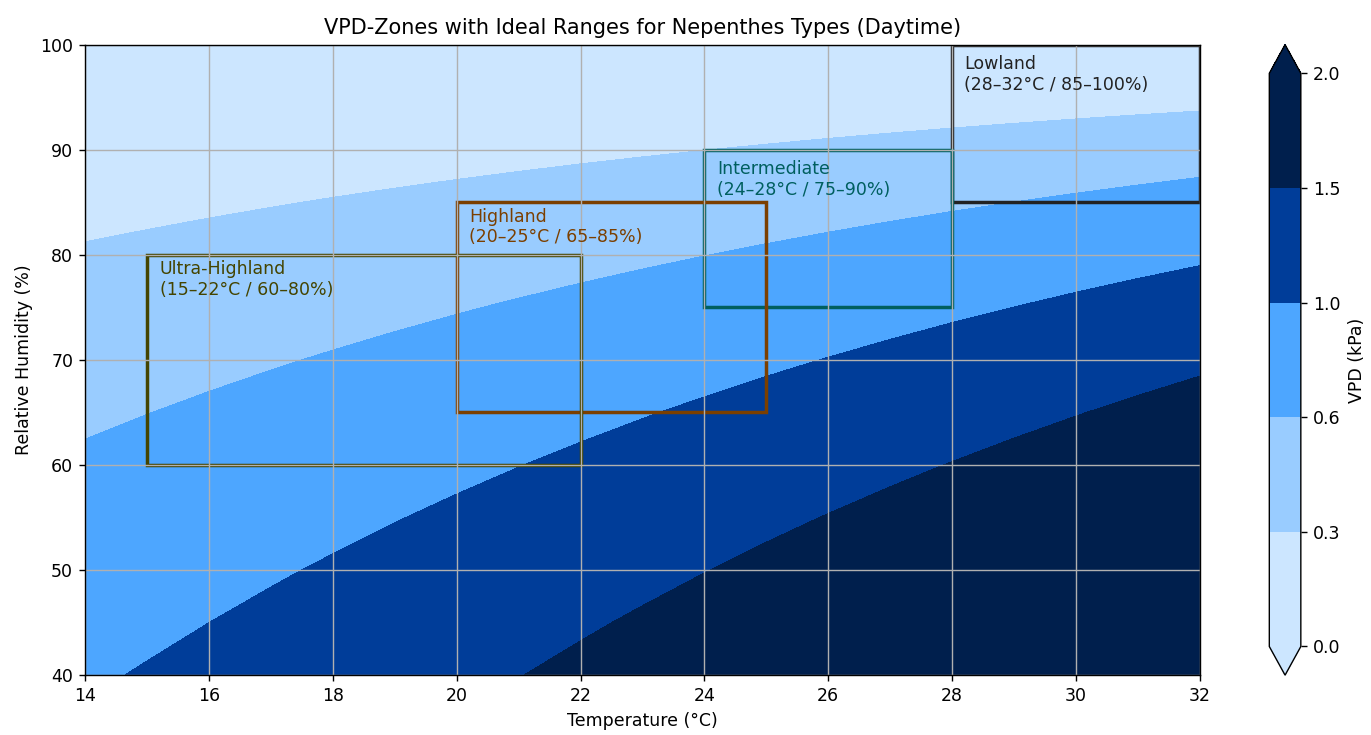
The graphic on the right provides general guidance on typical daytime temperatures for different Nepenthes groups. This categorization is based mainly on altitude, but it is not always exact, since there are microclimatic особененности local to the natural distribution of certain species. For this reason, species-specific research is always recommended.
While many Nepenthes show some tolerance for deviations from ideal conditions, ultra-highland species in particular react very sensitively to excessive temperatures or low humidity. For these species, keeping conditions as close as possible to the ideal range is essential for vitality and survival.
### VPD – Vapor Pressure Deficit as a Climate Factor
**[](https://carnipedia.org/uploads/images/gallery/2026-03/image.webp)**
**VPD (Vapor Pressure Deficit)** describes the evaporative demand of the air, meaning how strongly it is able to draw water from the plant. For plants, VPD is a key environmental factor because it directly influences how much water they lose through their stomata. This process is closely linked to CO₂ uptake for photosynthesis as well as the transport of water and nutrients within plant tissues.
#### Calculation
- **Saturation Vapor Pressure (es):**
The maximum vapor pressure the air can hold at a given temperature.
`e_s(T) = 0.6108 · exp((17.27 · T) / (T + 237.3))`
(*T* in °C, result in kPa)
- **Actual Vapor Pressure (ea):**
Vapor pressure according to relative humidity.
`e_a = e_s(T) · RH / 100`
- **VPD (Vapor Pressure Deficit):**
Difference between saturation vapor pressure and actual vapor pressure.
`VPD = e_s(T) - e_a`
#### Importance in Cultivation
- **VPD too high:** The air removes too much moisture from the leaves, creating a risk of drought stress.
- **VPD too low:** Transpiration is greatly reduced, so water and nutrient uptake function poorly.
Modern climate controllers and hygrometers can display VPD or even regulate it automatically. In closed systems such as display cabinets, terrariums, or grow tents, this allows especially precise control while also improving energy efficiency.
# Nepenthes ampullaria
*Nepenthes ampullaria* is a very widespread, climbing species that is mainly found on the forest floor of tropical rainforests. It is distributed at altitudes ranging from sea level to over 1000 m above sea level. Its range extends over a large part of the Southeast Asian island zone. Its unique feature is that it produces carpets of pitchers on the ground, formed from numerous basal shoots. These serve to catch all material that falls from above. In addition to insects, this includes leaves and other organic material. Nepenthes ampullaria is therefore a detritivore. To this end, the lids of the pitchers are folded upwards or completely backwards. Some frogs (Microhyla nepenthicola) even live in their pitchers, and their tadpoles grow up in them.
The leaves of the basal shoots are usually so small that only the pitchers can be seen in large numbers, and not the leaves. However, in favor of the basal shoots, tall pitchers are very rarely formed in nature or in cultivation. In general, the pitchers of Nepenthes ampullaria are more barrel-shaped or egg-shaped.
In cultivation, *Nepenthes ampullaria* can quickly reach considerable sizes. Individual leaves grow to about 25 cm long and 6 cm wide, but bend down slightly after fully unfolding and beginning to form pitchers. The approximate maximum diameter of the plant should therefore be around 50 cm. In relation to the size of the leaves, the pitchers formed are relatively small. A maximum height of approx. 10 cm and a width of 7 cm can be expected. The vast majority of Nepenthes ampullaria in cultivation originate from lowland or intermediate origins. This species tolerates a wide range of temperatures and humidity levels, although a consistently high humidity is strongly preferred. The minimum temperature at night should ideally not fall below 15 °C, and a temperature above 20 °C is desirable.
*Nepenthes ampullaria* is a fairly readily available plant that is suitable even for beginners. There are also a variety of color variants and hybrids with Nepenthes ampullaria, which have adopted some of the characteristic features of the pitchers. The lids are always slightly wider, revealing hybridization, even if the pitcher shape is still reminiscent of a pure species.
## Cultivation
### Ideal Conditions
Parameter
Suggestion
Notes
**Temperature (Day)**
22–35 °C
e.g Many plants grow well between 20–30 °C.
**Temperature (Night)**
20–25 °C
e.g. Shouldnt fall below 15 °C
**Light**
100–300 PPFD
Information about light habits of the plant
**Humidity**
80–100 %
Describe the plants preferred humidity conditions and if theres special characteristics about it, like evaporation protection (indumentum) or smthg like this
### Substrate & Fertilizing
Parameter
Suggestion
Hinweise
**Substrate**
List Substrates
Organic or Mineral Substrate preferred
**Potsize**
eg. bigger or small pot
e.g. the plant roots very wide and has more or less sensitive roots
**Watering**
Always keep very moist
Maybe natural occurence habits, peaty swamps, only epiphytic...
**Fertilizing**
Amount and frequency (eg. 500 µS every week)
mineralic fertilizer
**Fertilizer Tolerance**
medium to high
e.g. Pitchers get damaged if fertilizing was too much
### Unique characteristics
- Bildet Teppiche aus zahlreichen Basaltrieben
- Sehr schnelles Wachstum bei hohen Temperaturen
- Hochkannen werden nur selten gebildet
- In vielen Farbvarianten erhältlich
## Galery
### General Pictures
## Weblinks
- [Wikipedia – Nepenthes ampullaria](https://en.wikipedia.org/wiki/Nepenthes_ampullaria)
- [Nepenthes ampullaria on iNaturalist](https://www.inaturalist.org/taxa/346348-Nepenthes-ampullaria)
- [More Nepenthes-Species on Carnipedia](https://carnipedia.org/books/nepenthes)
# Nepenthes Template
*Descriptive Text, Just look on other pages for content examples*
## Cultivation
### Ideal Conditions
Parameter
Suggestion
Notes
**Temperature (Day)**
22–35 °C
e.g Many plants grow well between 20–30 °C.
**Temperature (Night)**
20–25 °C
e.g. Shouldnt fall below 15 °C
**Light**
100–300 PPFD
Information about light habits of the plant
**Humidity**
80–100 %
Describe the plants preferred humidity conditions and if theres special characteristics about it, like evaporation protection (indumentum) or smthg like this
### Substrate & Fertilizing
Parameter
Suggestion
Hinweise
**Substrate**
List Substrates
Organic or Mineral Substrate preferred
**Potsize**
eg. bigger or small pot
e.g. the plant roots very wide and has more or less sensitive roots
**Watering**
Always keep very moist
Maybe natural occurence habits, peaty swamps, only epiphytic...
**Fertilizing**
Amount and frequency (eg. 500 µS every week)
mineralic fertilizer
**Fertilizer Tolerance**
medium to high
e.g. Pitchers get damaged if fertilizing was too much
### Unique characteristics
- Bildet Teppiche aus zahlreichen Basaltrieben
- Sehr schnelles Wachstum bei hohen Temperaturen
- Hochkannen werden nur selten gebildet
- In vielen Farbvarianten erhältlich
## Galery
### General Pictures
## Weblinks
- [Wikipedia – Nepenthes ampullaria](https://en.wikipedia.org/wiki/Nepenthes_ampullaria)
- [Nepenthes ampullaria on iNaturalist](https://www.inaturalist.org/taxa/346348-Nepenthes-ampullaria)
- [More Nepenthes-Species on Carnipedia](https://carnipedia.org/books/nepenthes)
# Nepenthes campanulata
*Nepenthes campanulata* is a rather small species native to East Kalimantan in Borneo. It has several rather unusual characteristics that are not found in many other species. These include its very compact growth habit and the fact that it does not climb. Plants with a height of around 10-30 cm are already fully grown and capable of flowering.
In addition, the pitchers have only a very narrow peristome, which is why it is sometimes referred to as the lowland *Nepenthes inermis*. The pitchers reach only about 5 to 10 cm in size and do not have a particularly long lifespan. However, the pitcher opening is very wide and can reach up to 5 cm in diameter. The leaves grow to around 12 cm long and 2 cm wide.
Occurrences of *Nepenthes campanulata* are found on moss-covered limestone cliffs that are otherwise mostly devoid of substrate, at elevations of 300 to 400 m above sea level. Some of these sites are located directly on steep slopes. The habitats have high humidity and are very bright.
This species prefers daytime temperatures of 24 °C to 30 °C and nighttime temperatures not below 18 °C.
*Nepenthes campanulata* is a fairly widely available species, although it can still be problematic for some growers when kept as a pure species. There is also a wide range of hybrids involving *Nepenthes campanulata*, many of which have inherited the characteristic bell-shaped pitcher opening. Most plants available in cultivation have purely green pitchers, although a few forms with red speckling inside the pitchers are also known.
## Cultivation
### Ideal Conditions
Parameter
Suggestion
Notes
**Temperature (Day)**
24–28°C
Works well in Lowland to Intermediate tropical climate
**Temperature (Night)**
18–22 °C
Shouldnt fall below 15 °C
**Light**
100–300 PPFD
Growths lithophytic on limestone cliffs, with constant small amounts of water running down the wall, gets a fair amount of light. Still all in cultivation from Gunung Mulu site arent that exposed to light
**Humidity**
40–90 %
It seems that also lower humidity isnt an issue for this species, still a bit higher amounts seems to be fine at around constant 60-70%
### Substrate & Fertilizing
Parameter
Suggestion
Notes
**Substrate**
AKP, Sphagnum mixed with Limestone
AKP is working well, [Nerz](https://en.wikipedia.org/wiki/Joachim_Nerz) said he uses Sphagnum 3/4 with limestone 1/4. Akadama/pumice 50/50 can work very well too.
**Potsize**
medium
The plant has really sensitive roots which break off with ease. Preventing often repots by choosing a pot which fits it for a long time is better
**Watering**
Always keep very moist
Seems to doesnt like to sit in water or having drops on the leaves for too long
**Fertilizing**
around 500-1000 µS every week
Needs a bit more fertilization than other Nepenthes species
**Fertilizer Tolerance**
high
Feels good with a good amount of fertilization
### Unique characteristics
- Non vining species
- Fresh and still folded leaves and tendril tips can appear black cause of the hairs
- Roots are very fragile
- Flowers even with just 10cm diameter and very regularly
- Doesnt produce upper pitchers, but the maturity changes the appearance of the pitchers a bit
- Difficult to hybridize as the seed parents: probable endospermic incompatibility
## Galery
### General Pictures
[  ](https://carnipedia.org/uploads/images/gallery/2026-03/signal-2025-10-25-115412-003.jpeg)