
* General Information About Nepenthes
Nepenthes Propagation and Climate Notes
Propagation
Sexual Propagation
Pollination
- Nepenthes are dioecious plants.
- Fresh pollen must be applied to the sticky stigma of the female plant.
- Pollination was successful if the seed capsules begin to swell.
- Seeds are ripe when the capsule becomes very dry and opens under slight pressure or splits open on its own.
Raising Seedlings
- Seeds germinate best when they are very fresh.
- Seeds are sown on the surface of the substrate, as they are light germinators.
- Fertilizing with something like Osmocote placed 2–3 cm below the substrate surface can greatly accelerate seedling growth.
- Seedlings should be pricked out when the substrate surface becomes overgrown with moss and the seedlings have 2–3 pitcher-bearing leaves.
Vegetative Propagation
Cuttings & Nodes
- Use top cuttings or shoot cuttings with at least 1 node, ideally 2–3 nodes.
- Cuttings should be taken with a clean, sharp knife.
- Leaves may be cut in half or reduced to one third of their size to reduce water loss.
- Insert the cuttings into moist substrate, such as a sphagnum-perlite mix.
- Ensure high humidity.
- Place them in a warm environment (around 25 °C) with bright light.
- Rooting can take several weeks to several months.
Basal Shoots
- Basal shoots are side shoots growing from the base of the mother plant.
- Separate the shoot carefully, ideally with its own root system already forming.
- Care is the same as for cuttings: warm, humid, and bright conditions.
General Notes on Climate in Nepenthes Cultivation and the Importance of VPD
Nepenthes are tropical plants with very different requirements in terms of temperature, humidity, and light. These differences are determined by the habitats the plants originally come from, which can vary greatly in these conditions even within tropical regions. Altitude is especially important, as it strongly influences temperature patterns and humidity in the natural habitat.
Light intensity also depends greatly on location. Some species grow close to the ground in the shade of dense vegetation, while others are epiphytic or climbing plants that seek greater light exposure. In higher mountain regions, sunlight can be quite direct because the surrounding vegetation is less dense. Frequent rainfall and fog also affect light conditions through diffusion and shading.
The graphic on the right provides general guidance on typical daytime temperatures for different Nepenthes groups. This categorization is based mainly on altitude, but it is not always exact, since there are microclimatic особененности local to the natural distribution of certain species. For this reason, species-specific research is always recommended.
While many Nepenthes show some tolerance for deviations from ideal conditions, ultra-highland species in particular react very sensitively to excessive temperatures or low humidity. For these species, keeping conditions as close as possible to the ideal range is essential for vitality and survival.
VPD – Vapor Pressure Deficit as a Climate Factor
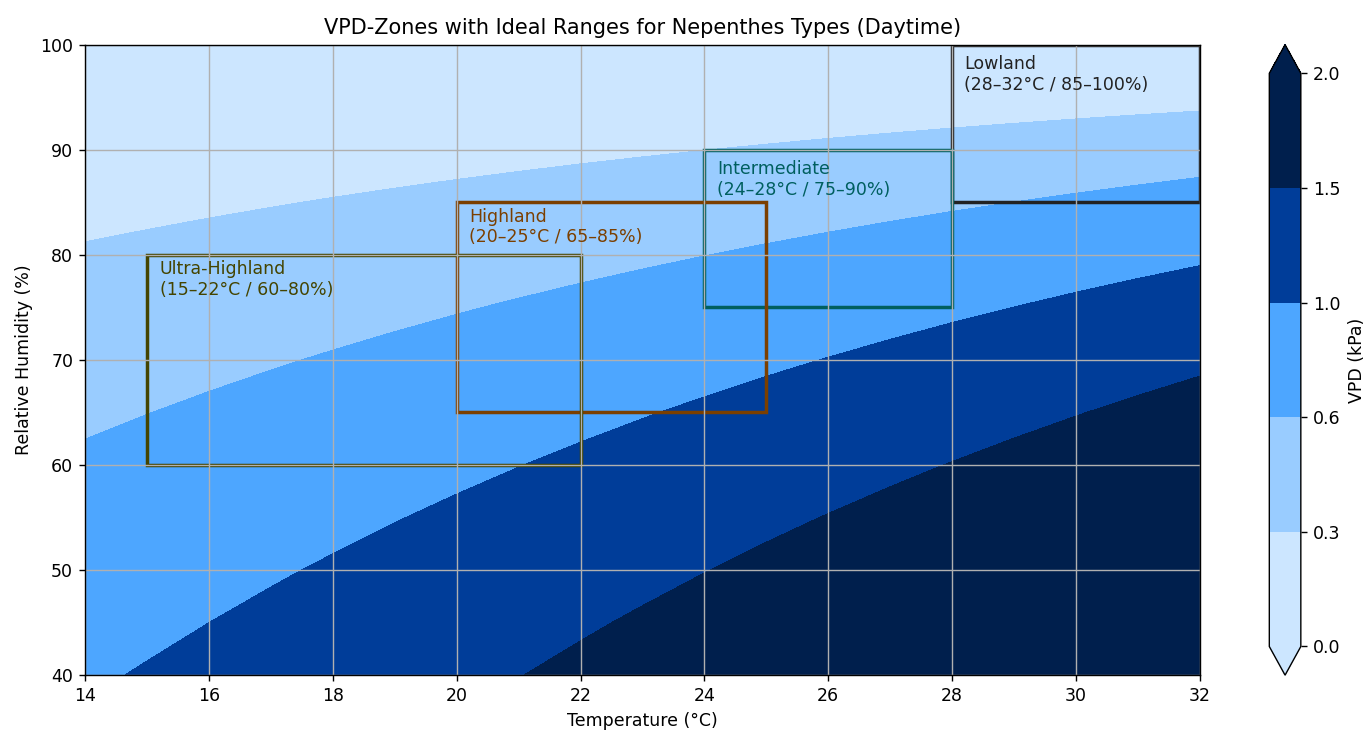
VPD (Vapor Pressure Deficit) describes the evaporative demand of the air, meaning how strongly it is able to draw water from the plant. For plants, VPD is a key environmental factor because it directly influences how much water they lose through their stomata. This process is closely linked to CO₂ uptake for photosynthesis as well as the transport of water and nutrients within plant tissues.
Calculation
- Saturation Vapor Pressure (es):
The maximum vapor pressure the air can hold at a given temperature.e_s(T) = 0.6108 · exp((17.27 · T) / (T + 237.3))
(T in °C, result in kPa) - Actual Vapor Pressure (ea):
Vapor pressure according to relative humidity.e_a = e_s(T) · RH / 100 - VPD (Vapor Pressure Deficit):
Difference between saturation vapor pressure and actual vapor pressure.VPD = e_s(T) - e_a
Importance in Cultivation
- VPD too high: The air removes too much moisture from the leaves, creating a risk of drought stress.
- VPD too low: Transpiration is greatly reduced, so water and nutrient uptake function poorly.
Modern climate controllers and hygrometers can display VPD or even regulate it automatically. In closed systems such as display cabinets, terrariums, or grow tents, this allows especially precise control while also improving energy efficiency.